
Blog > Risks in Real Estate Syndication and How to Mitigate Them
Introduction: The Inherently Risky Nature of Syndication
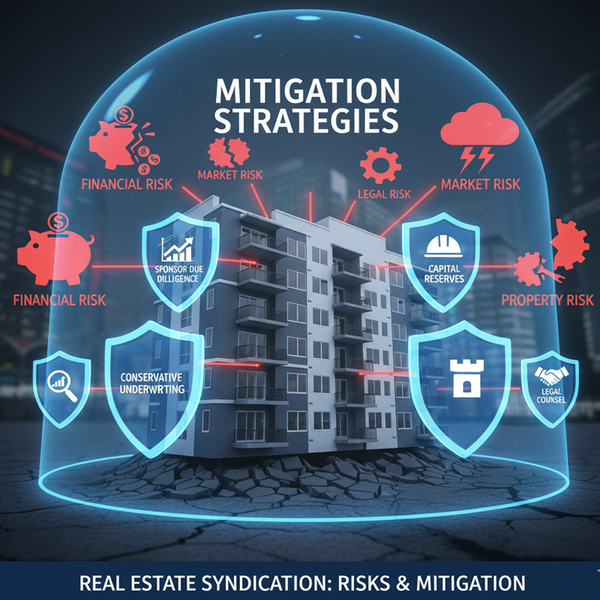
Real estate syndication is a powerful mechanism that allows investors to pool capital to acquire larger, more complex properties than they could individually. While offering the promise of attractive, passive returns and diversification, it is not without significant risk. Understanding these risks is the first step toward smart investing. When passive investors (Limited Partners or LPs) entrust their capital to a sponsor (General Partner or GP), they are exposed to a range of potential issues, from localized property problems to broad economic downturns. Effective due diligence and clear mitigation strategies must be in place to protect the investment from capital loss and ensure the projected returns are achievable.
Mitigating Sponsor and Management Risk
One of the most critical, yet often overlooked, risks in syndication lies with the sponsor or General Partner (GP) managing the deal. This is often called "Sponsor Risk" or "Execution Risk." The GP's inexperience, poor property selection, dishonest practices, or inability to execute the business plan (e.g., failing to complete a planned renovation on budget) can destroy investor returns. To mitigate this, LPs must perform rigorous due diligence on the sponsor, focusing on their track record, alignment of interest (do they have significant personal capital invested?), and transparency. A detailed operating agreement that clearly outlines the GP's duties, fees, and conditions for removal is also a vital protection.
Navigating Market and Economic Risk
Real estate is cyclical and highly sensitive to macro-economic forces, presenting significant Market Risk. This includes broader issues like regional economic contraction, unexpected population shifts, or sudden increases in local supply that drive down rents. Most notably, rising interest rates or a national recession can dramatically decrease property values and investor demand. Mitigation requires conservative underwriting: the sponsor should stress-test the business plan against worst-case scenarios, such as 10-15% lower occupancy or higher-than-expected operating expenses. Additionally, choosing markets with strong, diverse economic drivers, rather than relying on a single industry, helps insulate the asset from localized economic shock.
Addressing Property and Operational Risk
Operational risks are those tied directly to the physical asset and its day-to-day management. These include unexpected capital expenditures (e.g., a boiler failing, a roof requiring premature replacement), higher-than-anticipated vacancy rates, or poor property management leading to high tenant turnover. This directly impacts cash flow and the ability to service debt. The primary mitigation is thorough pre-acquisition due diligence through a professional inspection. Furthermore, the syndication must maintain adequate capital reserves, typically set aside at closing, to cover unexpected maintenance costs, ensuring that necessary repairs can be made without requiring a sudden capital call from investors.
Controlling Financial and Capital Stack Risk
The capital structure, particularly the use of debt, introduces Financial Risk. The most common pitfall is refinancing risk, where a short-term loan matures during a period of high interest rates or tight credit markets, forcing the sponsor to secure more expensive debt. Other risks include interest rate hikes on floating-rate debt, which can quickly erode cash flow. Mitigation involves carefully structuring the debt. Sponsors should favor long-term, fixed-rate financing when possible, or employ interest rate caps if using floating-rate loans. They should also secure commitment for contingency financing or ensure sufficient cash flow exists to withstand short-term interest rate spikes.
Understanding Legal and Regulatory Compliance Risk
Syndication deals are heavily regulated by securities laws (SEC in the US) to protect investors, introducing a layer of Legal and Regulatory Risk. Non-compliance, such as improperly classifying investors, using misleading marketing materials, or failing to adhere to disclosure requirements, can result in heavy fines, legal disputes, and the unwinding of the deal. Furthermore, disputes over partnership management can occur between the GP and LPs. Mitigation requires that the sponsor retain experienced securities counsel from the outset to structure the offering correctly. Investors, meanwhile, should thoroughly review the Private Placement Memorandum (PPM) and the Operating Agreement, ensuring that they clearly understand the rights, obligations, and legal recourse available to them.
GET MORE INFORMATION